

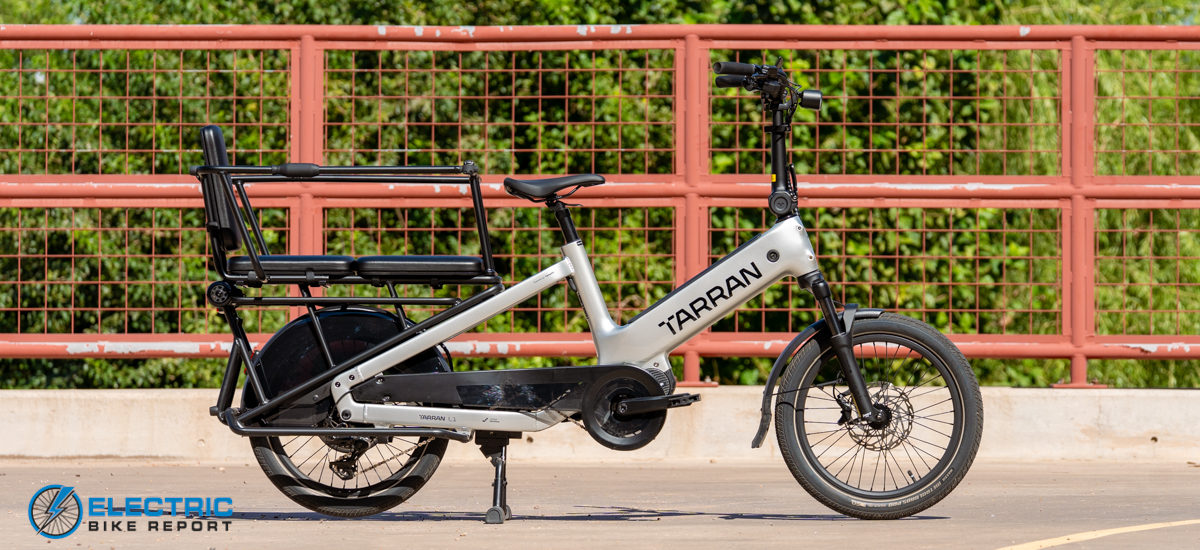
As we’ve seen the Tarran L1m performed well in our standardized performance testing, but in this section, we’ll dive deeper into the subject of how the bike feels to ride. Overall, it delivered a comfortable, high-tech experience, though it’s not without some room for improvement.
Sizing and adjustability are major highlights of the bike. Its single frame size accommodates riders from 5’1″ to 6’5″ through a myriad of adjustment points. As with nearly all e-bikes, the L1m’s saddle can be adjusted on its rails, and it offers height adjustment at the seatpost—150mm of length, plus an additional 150mm via the included quick-adjust dropper.
On the front end, a telescoping stem also allows for rotation adjustment to change the bike’s reach, and another quick-release clamp on the top of the stem allows the handlebar angle to be adjusted. All in all, it’s one of the most adaptable e-bikes I’ve had the chance to ride, with plenty of ways to ensure a comfortable fit.
The 80mm suspension fork and 2.4″-wide tires did a great job of keeping the ride smooth. As for contact points, the bike’s ergonomic rubber grips and sport-style saddle felt well-balanced between soft and supportive. I’d likely swap out the grip-tape-coated pedals for a set of studded platforms for extra grip, but the default setup felt great otherwise.
In terms of handling, the L1m steers and corners predictably. With Ryan onboard as a passenger, some frame flex was noticeable, but not to an unusual degree. Starting up while carrying a full payload felt somewhat shaky, and I had to countersteer somewhat to compensate for some added pull to the side, but all of these characteristics are normal for a loaded longtail cargo bike.
As I’ve touched on above, the motor’s smooth, refined feel and seamless power delivery were highlights. At times, it was easy to forget I was riding an e-bike when going by feel—pedal assist often faded into the background. Even when carrying cargo, the bike felt natural and intuitive, though it was more clear then that the motor was doing a significant amount of work to make my experience easy.
The L1m’s user interface was another highlight, with the Tarran app and the bike’s touchscreen display combining to make the riding experience feel advanced and convenient.
The interface’s aesthetic looks clean, sharp, and well-organized. Riders have immediate access to ride tracking, bike settings, and, once paired with the app, navigation. When a route is planned via the app, it can be mirrored to the display—a cool feature that looks great, though it does require the paired phone to be left unlocked to work correctly. While this is a minor point of critique, I’d love to be able to close/lock my phone and keep it in my pocket while riding.
That limitation aside, the app is extremely useful. Since the L1m is connected to 4G/LTE networks, the app can be used to track its location and monitor movement notifications when the bike is set to Sentry Mode. Perhaps most importantly, the app can be used to lock/unlock the bike, which I found a slightly more user-friendly solution than using the included NFT security cards.
FYI, about the LTE connectivity—these features are free for the first year of ownership, but like other bikes with this feature, an annual subscription (around $50) is required for subsequent years.
As I touched on in the introduction, the Tarran L1 comes in two spec tiers: the m (Manual) base model, and the fully-equipped s (Superior) model. Both are equipped with the same base specs, though the Superior model features an auto-shifting Enviolo CVT, an electronic dropper post, turn signals, onboard cameras, and a self-deploying motorized kickstand.
Owners of the L1m can add on many of the Superior’s features to upgrade the bike over time, which is great for buyers who don’t want to spring for the $6k+ model right out of the gate.
Overall, the bike’s control panel may present a bit of a learning curve to new riders; it’s loaded with buttons and even a dial—the functions of which aren’t immediately apparent. Fortunately, the bike’s operation is relatively straightforward once you understand the button layout, but buyers should be aware that, without the Superior model’s add-ons, many of the L1m’s buttons don’t function, since they have nothing to operate.
I appreciate the fact that Tarran divided the bike into two models, both for riders with lower budgets, and those who simply don’t need some of the top-tier features.
My only real point of critique here is that, considering the fact that many riders of the L1 will be carrying child passengers and riding on streets, the base model doesn’t include turn signals. I encourage Tarran to outfit the bike with these going forward—which could be easy, considering that its taillight seems to have the option for integrated turn signals already.
Otherwise, the bike feels worth its price, with a connected, comfortable, and premium user experience. It arrives fully functional as a cargo bike, though many riders will likely need to outfit it with some of Tarran’s wide range of optional accessories to get the most from it. As you might expect, this will add cost to the bike—so plan accordingly.
One final note is that the L1 can stand and roll vertically for storage in relatively small areas. This allows the bike to reduce its footprint and take up less space, which is extremely convenient for those without a garage or large living space.