
While it’s not as directly measurable as the previous performance sections, the subject of ride quality—how a bike feels to use and operate—is every bit as important. In this section, we’ll detail aspects such as sizing, fit, handling, the UE Carbon’s user interface and app functionality, and other areas.
To avoid burying the lead, the UE’s overall ride quality is excellent. Like any e-bike, it has some areas with room for improvement, but in the grand scheme of things, these are relatively minor concerns that don’t largely affect its user experience.
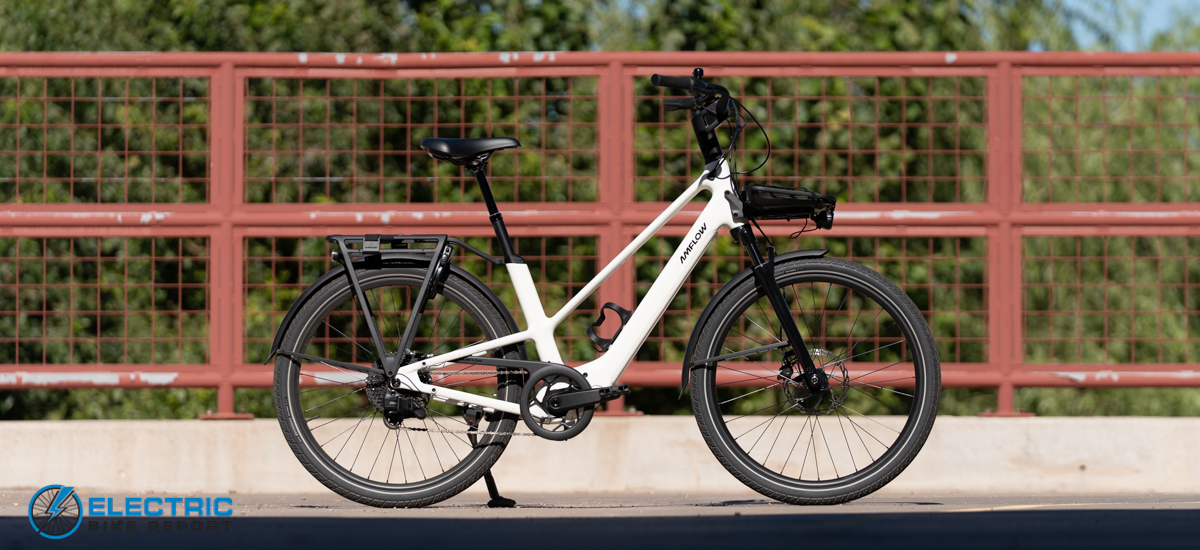
In terms of sizing, the UE Carbon is made in a single mid-step frame size meant for riders from 5’1″ to 6’3″. Amflow went to uncommon lengths to maximize comfort and ergonomics, as the bike ships with two stem options—one with 82.4mm of rise, and another with 129.3mm. There’s also around 9 inches of saddle height adjustment, including 125mm of travel via the quick-adjust dropper seatpost.
At 5’11”, I found the bike well-sized and very comfortable. I preferred the taller of the two stem options, which encouraged a more upright posture for my height. I was able to set the saddle for full leg extension, making my pedaling both comfortable and efficient. Even with the taller stem, the handlebars were somewhat on the low side, but overall, the bike was comfortable and pleasant to ride.
When it comes to handling, the UE Carbon had a relatively unique mix of airyness and plantedness. At nearly 60 lbs, it’s not exactly light, but its carbon fiber construction does make a difference; a comparable aluminum e-bike would likely be at least 10 lbs more.
With the included cargo racks and mid-drive motor, the bike’s weight felt manageable and balanced. It felt stuck to the ground, while also feeling highly maneuverable, responsive, and easy to steer. I did notice some frame flex when cornering, but this wasn’t egregious or unexpected for the UE’s frame design.
In my experience, the ride felt remarkably smooth. The bike’s dropper seatpost includes 30mm of suspension travel, which, when combined with its 65mm suspension fork, carbon frame, and 2″-wide city tires, effectively softens and absorbs bumps and road chatter. I was particularly impressed with the custom coil suspension fork; it felt so smooth and robust that I thought it was an air fork after my first ride.
I’ve touched previously on the motor’s smooth and responsive power delivery, but it’s worth reiterating how seamless it feels. From how quickly it can get up to speed and how easy it can make pedaling, the UE Carbon is clearly an e-bike, but it’s tuned so that it responds instantaneously to changes in the rider’s pedaling, making it feel like a much faster and easier version of an analog bike.
The base model we tested includes a 10-speed TRP drivetrain with electronic shifting that functions quickly and consistently while feeling super high-tech. Adjusting to the fact that shifting and switching pedal assist levels are both done via the combination control panel and handlebar-mounted display took a couple of rides, but overall, the system functioned well. I was also happy to note that, even when the battery runs out of charge, enough “juice” is kept in reserve to allow shifting to function for those who need to pedal home.
I mentioned above that, especially for its weight, the UE Carbon is remarkably well-equipped. While it’s not uncommon for e-bikes of its style to be equipped with lights, fenders, and a rear cargo rack, the UE goes a step or two further than most.
For example, its rear rack is MIK-HD compatible, meaning that it can carry up to 59.5 lbs and will work with many locking third-party accessories, including cargo baskets and storage bags. The bike also includes a cafe wheel lock, which shares a key with the removable battery, adding a layer of security for quick stops and in addition to physical locks and other security measures.
The UE Carbon has an integrated security system that includes GNSS sensors for GPS tracking and compatibility with Apple’s Find My system (Google Find Hub compatibility is also reportedly coming soon). Users can track and get directions to the bike’s location, activate an alarm, and receive abnormal movement alerts directly from the Avinox app.
There’s also an optional 6-digit security PIN requirement on startup, but the app can be used to turn the bike on/off to bypass this requirement. The bike’s integrated GPS sensors also allow for automatic ride tracking, and this data can be set to sync with Strava and/or Komoot through the app, too.
Many of the bike’s features and customization options can be accessed through both the Avinox app and the bike’s touchscreen display. Through one or the other, riders can pair with the app, adjust motor tuning, sync accessories such as DJI OSMO cameras or heart rate monitors, customize the display’s various ride data pages, and more.
One of the bike’s most interesting features is its automatic shifting mode, enabled through the TRP E.A.S.I. derailleur. I’ve tested a few similar systems, but this was among the best; Amflow offers a variety of parameters to adjust its behavior, including your desired pedal pressure, the speed and reactivity of the system, your preferred cadence, whether to shift in anticipation of pedaling when coasting, etc.
This mode generally worked well, once I had the settings dialed to my preferences. It functioned best when pedaling on flat and gently rolling terrain, effectively becoming a “set it and forget it” mode where I could focus more on my surroundings. I see this being ideal for riders who want an ultra-relaxed and easy way to enjoy some fresh air and light exercise.
Of course, without the ability to sense the surrounding terrain, any automatic shifting system is reactive instead of predictive. I noticed some chain popping when riding uphill, especially in the Eco assist level. Turbo seemed to have enough power to offset the load on the drivetrain. Fortunately, riders can also manually shift when using the auto mode, which may help to prevent excess wear caused by hilly terrain.
All in all, the UE Carbon offers a hugely connected experience that rewards those who are comfortable with its technology. This is something that prospective buyers should be aware of; the bike functions well for those who simply want to hop on and ride, but to get the most out of it, users should expect to spend some time learning and adapting to its relatively high learning curve.
Considering its highly connected nature, I appreciated that the bike included a magsafe-compatible stem-mounted phone mount. This allowed me to always have my phone front and center—and ensured my phone was well-charged—but it did also have a couple of drawbacks.
For example, the clamp on the mount was somewhat stiff, and when my phone was in place, it had a tendency to interfere with the side buttons. A unit that clamped the top and bottom of the phone instead of the sides may be more user-friendly.
Otherwise, I have to say that the UE Carbon was truly a joy to test and ride. At the time of writing, the bike’s price is TBD, but based on its feel and robust suite of features, there’s no doubt that it’s a premium product that delivers a highly refined and enjoyable experience.
My points of critique are relatively minor, which goes to show how well put together the bike is; it’s fun, agile, comfortable, responsive, extremely functional, impressively customizable, and uncommonly well-equipped.